
 |
 |
 |
 |
Full Discography
click title for info
Download Full Discography.pdf
- Sayat-Nova: Songs Of My Ancestors
- Leapfrog
- Oasis
- All Or Nothing At All
- Grand Ideas Vol. 1: Wave
- Grand Ideas Vol. 2: Mystic Heights
- Grand Ideas Vol. 3: Full Moon Music
- Quartet Language
- The Wayfarer
- Secrets
- Trio '87
- A Reverie: Solo Piano
- Stargazer
- Roy Ayers, Step Into Our Life
- Cosmology, Cosmology
- Billy Harper, The Believer
- Billy Harper, The Billy Harper Quintet
- Billy Harper, Trying to Make Heaven My Home
- Datevik Hovanesian, Listen to My Heart
- Julie Lyonn Lieberman, Mixing America
- Night Ark, Petals on Your Path
- Night Ark, In Wonderland
- Night Ark, Moments
- Bobby Vince Paunetto, Reconstituted
- Bobby Vince Paunetto, Commit To Memory
- Bobby Vince Paunetto, Composer in Public
- Mongo Santamaria, Sofrito
- Mongo Santamaria, Mongo and Justo
- Mongo Santamaria, A La Carte
- Mongo Santamaria, Afro Indio
- Rory Stuart, Hurricane
- Rory Stuart, Nightwork
- Various Artists incl. Armen Donelian Quintet, Positively Armenian 2
- Various Artists incl. Billy Harper Quintet, Jazz Jamboree 1980
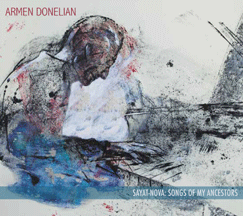
Armen Donelian, Sayat-Nova: Songs Of My Ancestors
(Sunnyside SSC 4018)
2 CD Set
Buy
Disc 1 - Solo Piano
•Where Do You Come From, Wandering Nightingale? / Oosdi Goukas Gharib Blbool?
•I Have Traveled The Whole World Over / Tamam Ashkhar Bdood Eka
•Without You, What Will I Do? / Arantz Kez Eench Goneem?
•Surely, You Don't Say That You Also Cry? / Ches Asoum Te Latz-es Eli?
•I'll Never Know Your True Worth / Hees Koo Gheemetn Cheem Geetee
•I Call Lalanin / Hees Ganchoom Eem Lalaneen
•Praised Among All Instruments (Kamanche) / Amen Sazi Mechn Govats (Kamanche)
•With The Nightingale You Also Cry / Blbooli Hit Latz-es Eli
•Were I Offered Your Weight In Pearls / Tekouz Koo Kashn Markrit Tan*
Disc 2 - Trio
All Songs Composed By Sayat-Nova (Public Domain) except (**) Composed by Khachatur Avetisyan.
•King Of Cathay / Shahkhatayee
•Your Headdress Is Silver And Silk / Tasdamazt Sim Oo Sharbab
•My Sweet Harp / Eem Anoush Davigh**
•You Are Golden And Exotic Brocade / Tipa Oo Yenkitoonia
•As Long As I Draw Breath / Kani Vor Jan Eem
All Arrangements Composed By Armen Donelian.Armen Donelian | piano
David Clark | bass
George Schuller | drums(2014) Disc 1: Recorded January 2013, Hudson, NY except (*) recorded May 2013, Firehouse 12 Studio, New Haven, CT. Disc 2: Recorded January 2013, Firehouse 12 Studio, New Haven, CT. All Mixed, mastered July - November 2013, Firehouse 12 Studio, New Haven, CT. (CD)
Quotes:
[
] While the 18th-century Armenian troubadour Sayat-Nova may not be a household name in the Western world, he has long been recognized as one of the greatest poets and troubadours to emerge from the Caucasus region. On the two discs that make up Sayat-Nova: Songs Of My Ancestors, the Armenian-American pianist Armen Donelian has prepared a deeply felt - and often strikingly beautiful - tribute to this distant master.
Most of Sayat-Nova’s songs survive only as simple melodies, offering considerable scope to the modern arranger. Donelian - who, in addition to having a long career in jazz, was educated in harmony and counterpoint - has broken his arrangements into two distinct groups: The first disc features solo piano versions of nine of Sayat-Nova’s compositions, while the second offers four more Sayat-Nova songs (plus one from Armenian folk musician Khachatur Avetisyan) performed as a trio with bass and drums.
The solo piano arrangements are, by far, the more extraordinary. Although Donelian is respectful of the original melodies, he also appears largely unbound by the constraints of any particular musical approach, using the spare frame of Sayat- Nova’s compositions more as a compass than a map. His expansive improvisations occupy a beautifully elusive place somewhere between the taciturn introspection of Erik Satie’s Gnossiennes, the modal lamentations of John Zorn’s Masada songbook and the genial invention of Art Tatum’s solo recordings. There are countless exquisite moments to be found within these nine extended meditations.
Next to such a carefully wrought offering, the trio disc cannot help but sound somewhat conventional. Although bassist David Clark and drummer George Schuller provide an agile and tightly focused rhythm section - and Donelian’s improvisatory flights are constantly informed by a graceful melodic sensibility - the piano trio format has a tendency to downplay the unconventional exoticism that makes the first disc so compelling. The trio performances are never less than satisfying, and there are numerous passages where the combo really cooks, but there is little on the second disc to match the revelatory quality of Donelian’s solo explorations.
In the course of his life, Sayat-Nova composed hundreds of songs, and their singular melodic language - at once disarmingly foreign and strangely familiar - seems to have offered Donelian a considerable well of inspiration. On the strength of the first disc alone, one can only hope that the songs on Sayat-Nova: Songs Of My Ancestors represent the beginning of a continuing partnership between the 18th-century master and his 21st-century disciple. - Jesse Simon, Downbeat (July, 2014)
Through the years, pianist Armen Donelian has worked with figures as diverse as Lionel Hampton, Chet Baker, Mongo Santamaria, Sonny Rollins and Paquito D’Rivera, as well as the fusion group Cosmology. On this two-CD set, he pays tribute to the 18th-century Armenian poet and minstrel Harutyun Sayatyan, known as Sayat-Nova (“King of Songs”). Acclaimed as one of his country’s foremost musicians and folk lyricists, Sayat-Nova performed in the court of Erekle II of Georgia until he allegedly fell in love with the king’s sister, resulting in his expulsion. He eventually became a priest in the Armenian Apostolic Church; he was killed in 1795 by the army of Agha Mohammad Khan Qajar, for refusing to denounce Christianity and convert to Islam.
Sayat-Nova, then, aside from his musical and lyrical gifts, was obviously a strong-willed man possessed by powerful, sometimes conflicting passions. Donelian eloquently captures this complexity. His readings of Sayat-Nova’s songs convey both spirituality and melancholy, emboldened by his forceful attack and the linearity of his improvisations. While remaining true to Sayat-Nova’s basic themes, he adds embellishments drawn from his own lifelong immersion in European classical music and American jazz as well as the traditional music of his Armenian heritage.
Disc 1 features Donelian on solo piano; disc 2 adds bassist David Clark and drummer George Schuller (sounding more “jazz” in conception and execution, if such a label must be used). Donelian’s meld of classicism and modernism - both tempered and enriched by his subtle but palpable wit - reflects Sayat-Nova’s own gift for balancing the dignity of the courtier with the romanticism of the minstrel. “I Call Lalanin,” allegedly a coded love song Sayat-Nova wrote for his secret royal paramour, is appropriately regal yet infused with both longing and - in Donelian’s ticklish upper-register curlicues - a playful sensuality. The desolation of “With the Nightingale You Also Cry” is redeemed by the bedrock dignity Donelian brings to it, along with the unabashed joy of discovery and new beauty that permeates his playing. Donelian slyly acknowledges the lineage between the modal nature of traditional Middle Eastern music and modern pop and jazz by inserting brief references to the Beatles’ “Norwegian Wood” and Miles’ “All Blues” into the brooding “Without You, What Will I Do?”; he infuses “Surely, You Don’t Say That You Also Cry?” with playful high-treble fillips and a propulsive, contemporary-sounding drive.
On the trio outings, Donelian relaxes his timbre and his tempo to ease into an unforced yet sturdy swing. “My Sweet Harp,” by the 20th-century Armenian composer Khachatur Avetisyan (the only non Sayat-Nova offering here), references Brubeck in both its time signature and its theme. “As Long As I Draw Breath,” befitting both its title and the trajectory of the composer’s life (as well as Donelian’s own approach toward, and realization of, Sayat-Nova’s vision) is imbued with a feeling of steadfast determination, expressed with gentleness and grace. - David Whiteis, Jazz Times (June 18, 2014)
[Editors’ Pick] Armen Donelian is a massively gifted pianist. There’s a graceful confidence and touch to his approach that’s rooted equally in jazz, classical and folk music. On Sayat-Nova: Songs Of My Ancestors, Donelian effortlessly intertwines the three while digging into the music of his Armenian ancestry. The songs of Armenian musician Sayat-Nova (1712–’95) have been handed down from generation to generation. Donelian grew up listening to this music, and on his new two-CD set, he updates the poet-composer’s work with a jazz sensibility and classical sheen to create a very modern-sounding joy. On the first disc, Donelian performs solo, demonstrating a command of the piano that few on the scene today can match. He lavishes in the lyricism of “Where Do You Come From, Wandering Nightingale? / Oosdi Goukas Gharib Blbool.” He adroitly straddles the folk and classical realms on “Surely, You Don’t Say That You Also Cry? / Ches Asoum Te Latz-es Eli.” He squeezes every ounce of heartache from “With The Nightingale You Also Cry / Blbooli-Hit Latz-es Eli.” He aches with love and sophistication on the eight-minute track “Were I Offered Your Weight In Pearls / Tekouz Koo Kashn Markrit Tan.” For the second disc, Donelian adds bassist David Clark and drummer George Schuller to the festivities. On “King Of Cathay / Shahkhatayee,” the trio glides across the sands, with Clark and Schuller maintaining an infectious, loping beat that’s combined with Donelian’s massive chops. Another lovely tune, “Your Headdress Is Silver And Silk / Tasdamazt Sim Oo Sharbab,” begins with Donelian stating the melody solo, and then Clark adds subtle arco work. When Schuller joins in, the tune takes off for a beautiful ride. “As Long As I Draw Breath / Kani Vor Jan Eem,” the closing number, tugs at the heartstrings and then explodes into an improvisational dream. The trio is locked, loaded and on fire. What’s so interesting about this 14-song program is that the melodies seem familiar yet hard to place. On one level, Donelian is reinforcing the importance of Sayat-Nova as a composer. But in the process of bringing these songs front and center, the pianist is also finding new inspiration in the ancient. It’s a powerful blend. On April 27, Donelian, Clark and Schuller will perform songs from Sayat-Nova at Castle Street Cafe in Great Barrington, Mass. – Frank Alkyer, Downbeat (April, 2014)
[Recommended] Alone and with a trio, Donelian plays works that inform his sense of who he is and confirm that great music is timeless and universal. The music of the Armenian composer Sayat-Nova (1712-1795) is redolent of Middle Eastern values, but as we become accustomed to musical idioms of the world melding, it would sound astonishingly modern even without the jazz and classical sensibilities that Donelian applies to it. Some of the solo pieces, notably “Without You, What Will I Do?” could have been written last week. Others prefigure Chopin. The trio performance of the minor “My Sweet Harp” with bassist Dave Clark and drummer George Schuller has profundity and sadness that Leos Janácek refined a century later. This two-CD album is certain to be regarded as one of 2014’s best. The invaluable 15-page booklet that can be downloaded from the CD should have been included in the package. – Doug Ramsey, Rifftides (May 5, 2014)
One can relate to pianist Armen Donelian’s Sayat-Nova: Songs of My Ancestors on many different levels. While most will not be familiar with the melodies of the 18th century Armenian minstrel whose corpus of work is presented here, Donelian uses jazz and classical styling to make the music immediately accessible yet keeping its cultural richness intact. Similarly, an American-born jazz musician re-experiencing his own ethnically distinct music through jazz is by now a familiar journey. An extensive digital booklet presents the history of both Sayat-Nova and Donelian in detail and anyone can also relate to the mixture of joy and pathos of continuing to breathe life into music and culture almost wiped out through genocide.
The first CD consists of solo piano renderings. The deceptive simplicity of opener “Where do you come from, Wandering Nightingale” engages the listener with strains of pathos, which prepares for the extremely powerful lament of “I Have Travelled the Whole World Over” and childlike wonder of the elegant melody within “Without You, What Will I Do?” Nothing, however, prepares for the sadness of “I’ll Never Know Your True Worth” or melismatic prayerfulness of “With the Nightingale You Also Cry”, as Donelian artfully combines Eastern European modes with jazz improvisation. “Were I Offered Your Weight in Pearls” concludes the disc. Recorded live, it is light-hearted and sets up a striking contrast to the previous pieces, providing a welcomed emotional respite and leading into the more upbeat trio performances that follow.
The second CD is as worldly as the first is introspective. With bassist David Clark and drummer George Schuller, Donelian takes the emotionally prepared listener on an instructional tour of the world according to Sayat-Nova and beyond. An upbeat “King Of Cathay” opens up in the Orient while “Your Headdress Is Silver And Silk” cleverly constructs a royal wedding. “You Are Golden And Exotic Brocade” reaches across time to mix a 19th Century melody with 21st Century jazz. Sayat-Nova’s best-known melody, “As Long As I Draw Breath”, returns to his inner self with a classically-inspired and masterful presentation. Sayat-Nova: Songs of My Ancestors is a moving performance of complex melodic structures, which, in Donelian’s expressive hands, reveal universal emotions of passion, sadness, pain, wonder and joy. - Elliott Simon, New York City Jazz Record (April, 2014)
The first thing that comes to mind when listening to pioneering pianist Armen Donelian (http://www.armenjazz.com)‘s new double album Sayat-Nova: Songs Of My Ancestors – due out on April 15 from Sunnyside (http:// www.sunnysiderecords.com) – is why aren’t these songs world-famous? Thanks to Donelian, someday they might be. With his new arrangements for solo piano and trio with bassist David Clark and drummer George Schuller, Donelian has reinvented over an hour and a a half worth of music by iconic 18th century Armenian composer Sayat-Nova. Celebrated as a national hero and a paradigm-shifting intellect whose plaintive, angst-ridden, often shattering melodies both resemble and predate Chopin by practically a century, Sayat-Nova is also renowned as a lyricist. He was a master of the kamancheh fiddle and the tar lute. His main gig was as a court minstrel for a local tyrant, a relatively cushy job, but one from which he was eventually fired. Within his compositions’ elegant, often enigmatic phrasing, there’s often a seething if restrained anger, and more frequently an absolutely depleted, wounded sensibility. We don’t know why Sayat-Nova got canned, or why he subsequently more or less abandoned music – at least professionally – joined the priesthood and later retired to a monastery. He may have known or figured out too much for his own good – or slept with someone he shouldn’t have.
Donelian’s feeling of kinship with Sayat-Nova is as strong as his passion for Armenian music in general, having played Armenian-influenced jazz for many years with reedman Souren Baronian, drummer Paul Motian and chanteuse Datevik Hovanesian. The operative question, obviously, is how to translate this music – written to incorporate the microtones of the fiddle and voice – for the rigid digits of the piano. Donelian does it chromatically. Yet while improvisation is the key to this whole thing – as it assuredly was when Sayat-Nova himself was playing it – Donelian keeps the main themes true to the originals. His arrangements and melodic variations maintain a similar consistency with the themes’ emotional content: this is a deep album. It’s not at Spotify yet, but watch for it after the release date.
The first of the double-disc set is solo pieces. What’s most stunning is how contemporary this music sounds even though some of it is 250 years old. The bittersweet lullaby Without You, What Will I Do? could pass for a rock ballad from the 70s, as does the gentler but considerably more jaunty I Call Lalanin (ostensibly a coded message to the composer’s secret love). The only concert recording here, Were I Offered Your Weight In Pearls switches up the time signatures as it recalls Dave Brubeck taking a stab at Chopin. The Polish composer is evoked – or, more accurately, prefigured – most vividly in the angst-ridden I’ll Never Know Your True Worth (the famous E Minor Prelude comes to mind).
Donelian brings out a similarly grim bitter edge and sense of longing to the plaintively crescendoing Where Do You Come From, Wandering Nightingale?, and the foresaken stranger’s lament I Have Traveled the Whole World Over. He blends elements of the Middle East and the neoromantic in Surely, You Don’t Say That You Also Cry? and Praised Among All Instruments. a late-career danse macabre that may foreshadow the composer’s downfall. The downright scariest of all the songs here is the Erik Satie-esque With the Nightingale You Also Cry, with its stunned, spaciously pitch-black sense of loss.
As you would expect, the second cd, with its jazz arrangements, is more rhythmically complex and improvisational. King of Cathay grows from a careful stroll with hints of Asian music to dancing variations; Your Headdress Is Silver And Silk builds out of an otherworldly, rapt intro with allusions to ragtime. You Are Golden And Exotic Brocade rises from a stately march to a snazzy, blues-tinged racewalk. The best of the trio pieces is the long, serpentine As Long As I Draw Breath, which foreshadows Satie again, Donelian bookending a long, loungey interlude with a morose waltz. There’s also a ringer here, My Sweet Harp, by a more recent Armenian composer, Khachatur Avetisyan, with a similar blend of creepy, stately and eventually Arabic tonalities. Donelian has stated that this is a lifelong labor of love for him, the high point of an already distinguished and original career and he’s probably right. He plays the album release show on April 4 at 7:30 PM at the Tenri Institute, 43A W 13th St.; $20 standing room tix are available. - New York Music Daily (March 24, 2014)
New York-based jazz pianist Armen Donelian’s latest album proves it is possible to celebrate Armenia’s rich cultural history from a contemporary perspective. The album “Sayat Nova: Songs of My Ancestors,” to be released nine days before the 99th memorial of the 1915 genocide, pays tribute to the 18th-century Armenian poet and troubadour’s revered original melodies, but does not shy away from more modern influences, most notably, mainstream jazz and classical music.
Having arrived in Armenia for the first time in 1998 as a performer at Yerevan’s First International Jazz Festival, Donelian saw a unique opportunity and applied for a Fulbright Research Grant to return for a more extended period. Despite immediate obstacles, ranging from basic language barriers to more complex ideological ones, Donelian’s return in 2002 saw him teaching the first formal course in American jazz, bebop style piano at Yerevan’s Komitas State Conservatory. He brought with him resources for jazz pedagogy and started a small jazz library in the conservatory at a time when, as he puts it, “materials had a tendency to disappear.” His time in Armenia has made an impact on not only his own personal musical aspirations, but also on current generations of Armenian musicians.
What inspired Donelian’s selection of Sayat Nova as the center of this project? Although the name Sayat Nova is familiar to Armenian households across the globe, his persona is shrouded in obscurity. Yet his contributions to Armenian literature have often been “compared to Shakespeare’s” and in music, “the beauty of his melodies rank with those of the greatest European composers.”
Donelian’s humility and appreciation for what Sayat Nova’s legacy represents to the Armenian community is apparent in the album’s booklet, he says. “I did not change this music. It changed me.” Sayat Nova’s music is just one piece of a puzzle within the larger scheme of Armenia’s vast cultural achievements, and Donelian’s liner notes place the music within a larger framework of the poet’s life and continuing legacy. The booklet is also replete with reflections and comments by Donelian himself on the album’s music.
Adapting the traditional folk melodies to solo piano was not always an easy task for Donelian. In a Skype interview, he explained some of these obstacles in greater depth: “The problem as a pianist is twofold. One…what you’re trying to do is imitate on a well-tempered instrument the sound of music that was created on a mobile instrument. That’s number one. Number two is that most of this music, at least in its original, folk form, is monadic. That is, it’s only a single line of music. Then, harmonies are only implied by the path of the melody. So, as we listen to that melody, we might get a sense of a harmonic or tonal center. But there’s no functional harmony… You know, when you encounter folk music of that nature, it’s quite a different mindset, a whole different approach. So, when I practice this music, what I’m trying to do is hear the music on its own terms, yet relate it somehow to the tradition and style that I’ve devoted my life to learning. And that’s taken some time. But I feel like with this new project of Sayat Nova music, I’ve done something that I’m really proud of and feel very good about. Because I’ve preserved the melodies of Sayat Nova, and infused them with harmonies that are truly contemporary.”
The incubation period for the album has been several years in the making, evident in Donelian’s skillful arrangements. Those for solo piano and jazz combo reflect a lifetime of musical encounters in and outside the realm of Armenian music. Some of the tracks on the album take on a highly classical character, as in “Tamam Ashkhar Bdood Eka,” which incorporates a wide range of 20th-century stylistic textures. Other songs, like “Tekouz Koo Kashn Markrit Tan,” draw heavily from Afro-Cuban elements, reminiscent of his time playing in Mongo Santamaria’s New York City jazz band in the 70’s. The album consists of two discs, with the second containing tunes arranged for jazz trio (piano, bass, and drums). Fans of Soviet-Armenian composer Arno Babajanian might recognize the tune in the song “As I Draw Breath,” which is the same heart-wrenchingly melancholic folk melody Babajanian used in his solo piano piece, “Elegia.” In a modern world in which the music of other cultures is so often trivialized and appropriated for the music industry’s commercial objectives, “Sayat Nova: Songs of My Ancestors” is a breath of fresh air. Its integration of Armenian culture in this commercial context does not go unexplained. And though not every listener may make it through Donelian’s lengthy album liner notes that detail Sayat Nova’s past, its presence on the album is a comforting testament to Donelian’s dedication to a larger cause: the present state of Armenia’s culture, as well as its future. – Karine Vann, Armenian Weekly (April 17, 2014)
Armen Donelian Group, Leapfrog
(Sunnyside SSC 4010)
Buy
Rage (Donelian) / The Poet (Donelian) / Winter (Donelian) / Behind The Veil (Donelian) / Bygone (Mommaas) /
Smoke (Donelian) / Mexico (Donelian) / Inner Sanctum (Donelian)Armen Donelian | piano
Marc Mommaas | saxophone
Mike Moreno | guitar
Dean Johnson | bass
Tyshawn Sorey | drums(2011) Recorded, Mixed and Mastered at Firehouse 12 Studio, July 2010 - January 2011, New Haven, CT (CD)
Download Leapfrog Press Release.pdfQuotes:
Hold on to your hat. This is Donelian's 9th set for Sunnyside, and even after a four decade career where he played with all the jazzbos that matter, he still might be the heaviest cat you never heard of. A New Yorker that likes to explore his Armenian roots, he is a piano improv player of the first order. This is an angular set of sitting down jazz that certainly doesn't take things lightly. Certainly the kind of cat that knows how to keep a foot in each of the past and the future, he's captured that vortex where moldy figs and progressives can meet and each be right about what they hear, even if they can't convince the other. Donelian and his crew know how to work up a sweat. - Chris Spector, Midwest Record (7/30/11)
While cohesion and individuality, by their very definitions, may seem to be at odds with one another, the music on Leapfrog reconciles these two opposing ideals without a problem. For his ninth date on the Sunnyside label, pianist Armen Donelian has together a program of strikingly modern originals that showcase the cutting edge talent and simpatico sensibilities of his band.
The personnel in Donelian's quintet might, at the surface, seem like an intergenerational mishmash, but that couldn't be further from the truth. Donelian and veteran bassist Dean Johnson began making music together in the early '80s, and the pianist's work as a jazz educator at institutions like The New School and William Paterson University brought him into contact, at various times, with tenor saxophonist Marc Mommaas, guitarist Mike Moreno, and rising-star drummer Tyshawn Sorey.
As individuals, each player puts his own imprint on the material at hand. With an ability to inhabit a groove, while simultaneously disassembling its parts, Sorey slams with cymbal-centric fury (”Rage”) and swings with a combination of taste and unrestrained abandon (”Smoke”), but he also knows how to play the minimalistic straight-man when the music calls for it (”Mexico”). Johnson proves to be the ultimate musical marksmen, nailing every musical hit and turn with a sniper's precision, but his skills don't end there. His big ears help him in helping others as he builds a comfortable, aural safety net around his band mates, and proves a strong soloist when stepping into the spotlight. Mommaas mines the mood of each piece to the fullest possible extent while Moreno, in similar fashion, manages to shift his sound from searing (”Rage”) to soothing (”Mexico”), suiting the nature of each number. While Donelian plays several different parts here, his most important role is that of a bonding agent. The quintet unites under the banner of his piano work, and he leads by example, as all good teachers should.
Leapfrog proves to be light years beyond many other albums that wear the modern jazz label, because the individual contributions and the confluence of the group are of equal value, and Donelian deserves plaudits for balancing that equation and producing such a work. - Dan Bilawsky, all•about•jazz (August 23, 2011)
The game of leapfrog is an anomaly. It’s not an exhibition of brawn, and it requires no premeditated strategy. It isn’t a team sport per se, nor is it characterized by star athletes or bouts of glorified showboating. It’s the essence of simple pleasure, a diversion free of competition, catalyzed by the vigor of its young players. Pianist Armen Donelian couldn’t have picked a more appropriate title for his ninth Sunnyside album. Leapfrog is a panorama of spacious arrangements, instrumental turn-taking and bounding euphony put forth by a team of voracious up-and-comers—guitarist Mike Moreno, tenorist Marc Mommaas and drummer Tyshawn Sorey. Donelian recruits veteran bassist Dean Johnson to anchor curiously modern compositions while diligently mentoring his contemporaries. Leapfrog is a vast lyrical playground in which Moreno, Mommaas and Sorey are free to roam, and it illustrates their heightened individual abilities and ranges. In the style of the game, Johnson and Donelian lay the foundation for their collaborators to saunter joyously between the former’s carouseling bass lines and the latter’s swirling piano calliope. On “Behind the Veil,” Moreno floats between shimmering chorus, subtle, ’60s-style tremolo, and warm solos, driving his point home with theatrical hammer-ons and sweeps. A master of restraint, Sorey refines his sound with a buttery-smooth brush technique but also knows how to swing, interchanging freewheeling, cymbal-fueled bop on “Rage” with tribal rhythm and ambient drop-outs on “Mexico.” Mommaas intelligently weaves in and out of the mix, navigating the spectrum of styles with eloquent interjections and circular breathing on “Bygone.” Donelian steps in when needed on “Smoke,” applying steadfast yet understated interludes. Leapfrog is a free-spirited road trip, not a think piece. It’s a landscape of hills and valleys traversed by a vehicle of both cohesion and personality. Plus, it’s fun—just like the childhood game. The tour itinerary on the Donelian’s website lists CD release shows at Firehouse 12 in New Haven, Conn. (Sept. 23), and at The Cornelia Street Cafe in New York (Sept. 24). - Hilary Brown, Downbeat Editors' Pick (September 2011)
One of the true veterans dotting the NYC landscape, Armenian-American pianist Donelian plays mainstream jazz with a verve and expertise typical of the upper echelon of performers. With nine recordings for the Sunnyside label since the 80's, Donelian has cemented his estimable reputation worldwide as a pro's pro. And he's a well-regarded teacher on the New School's faculty. A Fulbright Senior Scholar in 2002, he's also authored widely used instructional texts. This performance will be a CD release party, celebrating his latest recording Leapfrog (Sunnyside). Joining him will be Dutch tenor saxophonist Marc Mommaas, guitarist Mike Moreno, bassist Dean Johnson and drummer Tyshawn Sorey. - Michael G. Nastos, Hot House Spotlight (September 2011)
A prolific creator of music, pianist Armen Donelian’s latest recording Leapfrog is a continued foray into the interplay of musicians. Donelian has a terrific touch at the keys and notes, writing all but one of the tunes on a project that speaks in more contemporary musical vernacular. His compositions have a very fusionesque quality that serves as a solid platform for the musicians on the recording to display their individual virtuosity. Joining Donelian on this project is a very skilled quintet of guitarist Mike Moreno, bassist Dean Johnson, drummer Tyshawn Johnson and saxophonist Marc Mommaas. A very worthy artistic and contemplative effort. - theJazzPage.com, Raves (September 9, 2011)
Some jazz improvisers express themselves through original compositions, while others express themselves through standards. Of course, one doesn't automatically rule out the other; being standards-friendly doesn't mean that an improviser cannot be creatively successful as a composer. Different artists have different standards/original material ratios, depending on what they feel works best for them. On his Sunnyside recordings of the '90s and 21st century, Armen Donelian hasn't been terribly standards-obsessed; he might include one or two of them on an album, but his own compositions have often dominated his releases. And the acoustic post-bop pianist doesn't include any standards at all on Leapfrog, a self-produced 2010 date that employs Marc Mommaas on tenor sax, Mike Moreno on electric guitar, Dean Johnson on bass, and Tyshawn Sorey on drums. The only thing on Leapfrog that Donelian didn't compose is Mommaas' wistful "Bygone"; everything else on this 60-minute CD is a Donelian original, and that includes the edgy "Rage," the moody "Winter," and the angular, Thelonious Monk-ish "Smoke," as well as the reflective "The Poet" and the mysterious "Behind the Veil." Meanwhile, "Mexico" (which Donelian previously recorded in the early ‘90s) is an airy piece that, according to Donelian, is meant to aurally depict the wide-open spaces that one finds in the desert of northern Mexico, south of Arizona. Donelian the composer and Donelian the acoustic pianist are equally important on Leapfrog; both of them are crucial to the album's creative success. And while Leapfrog isn't quite as essential as some of the albums Donelian has recorded in the past, this is nonetheless a solid and absorbing effort from the veteran pianist/composer. - Alex Henderson, allmusic.com (September 13, 2011)
Recommended New Release - David Adler, The New York City Jazz Record (September 2011)
Armen Donelian Trio, Oasis
(Sunnyside SSC 4007)
Buy
Oasis (Donelian) / Spree (Donelian) / Sunrise, Sunset (Bock/Harnick) / Waiting For Flora (Donelian) / Django (Lewis) / Easy Does It (Donelian) / Lady Of Ghent (Donelian) / Sans Souci (Donelian)
Armen Donelian | piano
David Clark | bass
George Schuller | drums(2008) Recorded at Northern Track Studio, March 18, 2007, Wilmington, VT (CD)
Download Oasis Press Release.pdfQuotes:
Armen Donelian is not a familiar name in jazz, although those who have heard him play might wonder why. Oasis is his 11th release as a leader, and his impressive sideman credits include Mongo Santamaria, Sonny Rollins, Chet Baker, Paquito D'Rivera, and Thomas Chapin. The medium-tempo title track, "Oasis," is a gracefully structured and thoughtful Donelian composition. His creative phrases are lucidly articulated, and his ample technique is used only to capture the harmonic essence of his theme, not to mindlessly hide any lack of inspiration. Donelian has an appealingly delicate touch, and his classical training and early studies with Richie Beirach helped develop his sensitive, reflective and openly expressive approach to tunes such as this. Clark and Schuller, his rhythm team for the past four years, support him skillfully and sympathetically, and Clark contributes a finely crafted solo of his own. Now in his late 50s, the New York- born pianist of Armenian descent is a rewarding listen. Sample Donelian – you won't be disappointed. – Scott Albin, Jazz.com (2008)
Armen Donelian’s résumé is wide and deep, as leader, sideman, author, educator and (as a Fulbright Senior Scholar) cultural ambassador to Armenia, the land of his ancestors. Fortunately, when Donelian sits down to make a piano trio record (Oasis is his 11th), he does not wear his academic erudition or his ethnicity or even his chops on his sleeve. Instead he blends his influences into a seamless, balanced whole. Oasis quickly establishes a high level of musical discourse and never falters from it. Donelian’s poise makes everything sound measured and unhurried. Even on a fast, hard waltz like “Sans Souci,” his instinct is to slow it and gather it for thoughtful inspection.
His sweet spot is a particular, springy slow-to-mid-tempo, like the title track and “Lady of Ghent.” They are two of the six originals here, all fresh, elegant forms that retain their shapeliness even as Donelian freely embellishes them, his right hand often flowing into luminous treble cascades.
But the clearest evidence of Donelian’s compositional creativity may be his cover of “Django.” The first 3 1/2 minutes are an excursion far from it, retaining only the dramatic anticipation of John Lewis’ elegy. It is like a release of breath when the famous melody finally emerges. – Thomas Conrad, Jazz Times (2008)…While pianists Armen Donelian and Mulgrew Miller have clearly done their research, they have also moved beyond mere imitation and developed their own unique, artistic voices. Their trios feature original compositions, virtuoso piano playing and sympathetic drumming and bass playing, with one more thing in common between them--both are instructors in the jazz studies program at William Paterson University, less than an hour from NYC…
Donelian's Oasis begins with the title track and it's a beautiful, floating piece with a rhythmic basis somewhere between a bossa nova and soft R&B. It might remind a listener of Chick Corea or Keith Jarrett, yet its originality is undeniable. Even the two non-Donelian pieces - “Sunrise, Sunset” and “Django” - are satisfyingly organic, compositionally and improvisationally seamless. On the latter, for instance, Donelian's florid piano introduction melts into a softly singing bass solo--then his solo starts as a spare counterpoint texture that eventually gives way to a slightly more traditional linear right-hand, ending on John Lewis' enthralling original melody. “Sans Souci” ('carefree' in French) closes this CD: its light mood is no less technically accomplished or sophisticated than the other tracks and like most of the CD, refreshingly free of stiffness or pretense. In a music market filled with choices, this recording is an oasis of honest, multifaceted, breathing music. – Francis Lo Kee, All About Jazz (2008)A skilled pianist whose style and voicings are influenced most by Bill Evans, Armen Donelian puts his own musical personality in his explorations of modern mainstream jazz. Donelian, who also works as an educator, has led to more than ten CDs in his career thus far of which Oasis is a good example of his work. Teamed with bassist David Clark and drummer George Schuller, Donelian mostly explores his own harmonically sophisticated originals plus a straightforward rendition of John Lewis' "Django," and an offbeat but successful choice in "Sunrise, Sunset." His interplay with his sidemen gives the other musicians opportunities to influence his musical directions and the three players often seem to think like one. Although Oasis would have benefited from including more cookers, it has a nice balance of moods and tempos and, like all of Donelian's previous recordings, is enjoyable and thoughtful. – Scott Yanow, All Music Guide (2008)
Armen Donelian/Marc Mommaas, All Or Nothing At All
(Sunnyside SSC 4002)
Buy
Invitation (B. Kaper/P.F. Webster) / All Or Nothing At All (J. Lawrence/A. Altman) / Renwal (A. Donelian) / Children's Song (M. Mommaas) / Stargazer (A. Donelian)
Armen Donelian | piano
Marc Mommaas | tenor saxophone(2005) Recorded live at New School University, April 3, 2003, New York, NY (CD)
Quotes:
Much has been written about the art of the duo, particularly its musical and aesthetic requirements. As a musician who has done his share of duet playing, I can say that one could never write enough about this particular setting. It is the most demanding situation as far as technical virtuosity is concerned since both partners are so exposed. Matters of intonation for the horn player and the pianist’s dual challenge of playing solo and accompanying are obvious. But above all there is the need for the artists to tell a story because there is such heightened intimacy with the listener or audience if it is a live situation. Keeping interest is paramount and there is no drummer or bassist to assist in this regard. Next to solo playing (which believe it or not can be a rather solitary experience), in a duet one is as close to being naked in front of the public as is possible. Besides the obvious elements of melody, harmony and rhythm, the aspect of color is crucial for sustaining interest and arousing empathy from the listener. The performers must have such great command of their instruments that they are able to convey emotion and the story line through sound itself.
Armen Donelian is a true professional and one of the standard bearers of the New York piano scene for several decades having played with many of the greats of our time (Sonny Rollins, Mongo Santamaria, Chet Baker, etc.). In the early 1970’s, he spent a concentrated study period with my partner, Richie Beirach. Marc Mommaas, who grew up in the Netherlands and has spent a good deal of time in the past few years in New York, did some studying with me. Both Richie and I are very conscious of sound and the importance of being able to coax a wide variety of colors from one’s instrument. On this recording these two gentlemen generate a wide palette of sound to enjoy while sustaining interest, beauty and thoughtfulness throughout.
Their version of the title tune “All or Nothing at All” captures this range of nuance and sound. From Armen’s initial delicate piano intro leading into the melody chorus (where Marc’s tone reminds me in some ways of Stan Getz’s), the improvisations evolve in intensity as the walking bass line (that allows Marc freedom to be very loose with the beat) dissolves into a question and answer dialogue. Armen’s solo immediately launches into a polytonal interpretation after which Marc employs a beautiful sonic touch by using his high register played pianissimo nearing the end of the performance. Throughout this live recording (in which second takes and doctoring of the sound are unavailable options), the duo is in command of their sonic arena.
The original compositions all stand out both structurally and in the way the artists voyage through the various landscapes. Donelian’s “Renewal” moves through quiescence and lyricism to intensity and highly chromatic playing. Marc’s entrance on his original “Children’s Song” makes the tenor sound appear almost like a soprano. And Armen’s classic, “Stargazer” (which I had the pleasure to record years ago and is well known by musicians), gets the full treatment from chord changes to pedal point chromaticism as well as traversing a full range of emotions from joyous to dark and brooding.
Armen and Marc will make you feel like you are in the recital hall of New York’s famed New School with them. You can feel the audience’s intensity as they listen. The duo’s artistry is at the highest level because they are in full communication with each other, the music and the audience as well. This is art for serious people who enjoy being taken on an intense musical voyage. - CD liner notes by David LiebmanOn All Or Nothing At All, reedist Marc Mommaas and pianist Armen Donelian attack a mixture of standards and originals with a relatively straightahead post-bop feel. While they don’t employ any unusual concepts, their deeply intuitive connection is its own reward. The arrangements use lots of space, artfully juggle foreground and background roles, and reveal an impressive patience; this pair feels no need to fill every nook and cranny with sound. This sense of intimacy works because both players are fantastic listeners, and when Mommaas solos the pianist seems plugged right into his brain waves, perpetually altering his accompaniment to propel and caress the saxophone lines. – Peter Margasak, Downbeat (2007)
First, an admission: I am disinclined toward duo dates. To me, a piano and saxophone alone together often sound panicky, rushing to fill all that open space. They engage in a technical exercise, like fencing, with intellectual rewards more athletic than aesthetic.
All Or Nothing At All is different. To be sure, pianist Armen Donelian and tenor saxophonist Marc Mommaas set out a fierce, dense, austere contrapuntal recital. But they function within the duet format with such skill and creativity and taste that it is impossible for an open-minded audience not to have fun.
This particular open-minded audience filled the Jazz Performance Space at the New School University in New York City in 2003. The live sound is oddly monophonic yet captures the intimacy of the evening’s shared adventure, which is all about duality. For example, the 11 minutes of the title track contain a slow, luminous intro by Donelian; a horn-plus-accompaniment melody chorus with Donelian’s strong anchoring bass line and Mommaas’ free forays; frenetic, inspired, loose call-and-response dialogue; an eruptive solo by Donelian creating complex polytonal commentary on the theme; another, more liberated shared melody chorus; and a haunting, piping, high-register coda from Mommaas.
So I ask myself, what’s not to like? – Thomas Conrad, Jazz Times (2006)All Or Nothing At All is jazz featuring a program of standards and originals. In his notes for this CD, David Liebman ably assesses the risks and rewards of the duo format, where, next to solo playing, “one is as close to being naked in front of the public as is possible.”
Pianist Armen Donelian and tenor saxophonist Marc Mommaas convey many emotions and moods on their CD (recorded in concert at The New School) and employ a variety of approaches and, in Mommaas’ case, wide-ranging tonal colors. Each track is carefully sculpted; i.e., the title song begins with a light-toned sax melody lead, easing into an improvisation over a piano with a walking bass line, then heating up as piano and sax dialogue in phrases breaking up the flowing 4/4 before a complex piano solo. Other highlights include Donelian’s “Stargazer,” with pedal chords and a sax solo ruminating in long tones before breaking out in arpeggios, and Mommaas’ “Children’s Song,” a waltz lullaby with a lovely light touch. – George Kanzler, All About Jazz (2006)This most recent record of Armen Donelian, versatile American pianist of Armenian origin, compels us to reflect on the challenging art of duo playing. To this end, the introduction of saxophonist and composer David Liebman, who briefly contributed to the artistic maturation of Donelian’s partner, tenor saxophonist Marc Mommaas, is very helpful.
This disc, a live recording made at the New School University Jazz Performance Space in New York City with no “alternate takes” typical of studio recordings, presents two well-known standards, the title track and “Invitation,” two compositions by Donelian, “Renewal” and “Stargazer,” the latter often played by jazz musicians, and one by Mommaas, “Children’s Song.” “Stargazer,” literally “one who stares at the stars,” is also the title of Donelian’s first record, in which Donelian leads a trio, complete with the Puerto Rican bassist Eddie Gomez and drummer Billy Hart, who is in demand and present in a variety of situations, not the least of which is the American Italian quintet of our trumpeter Marco Tamburin.
On the one hand, the standards are characterized by spirited dialogues between the piano and sax, sustained by Donelian’s elegant swing that stimulates a variety of hot improvisations by Mommaas, and on the other the three originals underline the poetic side of the musicians, with a more airy saxophone sound and more delicate and intimate piano playing.
This record bears repeated and careful listening, as with each one discovers new characteristics of the style and technique of the two musicians. – Giovanni Greto, Venezia News (2007)
Armen Donelian, Grand Ideas Vol. 1: Wave
Select Standards for Solo Piano
(Sunnyside SSC 1088)
Buy
I Will (P. McCartney/J. Lennon) / All of Me (S. Simons/G. Marks) / Solitude (D. Ellington/E. DeLange/I. Mills) / I've Grown Accustomed to Her Face (A. J. Lerner/F. Loewe) / Our Day Will Come (M. Garson/B. Hilliard) / Wave (A.C. Jobim) / Here, There and Everywhere (P. McCartney/J. Lennon)
Armen Donelian | solo piano
(2000) Recorded 1998-9, West Orange, NJ (CD)
Quotes:
Three records of solo piano music from Armenian-American pianist/composer Armen Donelian present three different pictures in this most vulnerable of setting. Wave offers a look at Donelian the stylist doing covers; Mystic Heights is a run through an all-Donelian program; while Full Moon Music is all spontaneous composition. These three volumes constitute his Grand Ideas solo keyboard cycle.
Wave shows something few artists have been able to do: play the standards across generations as if they were all part of one era. The two Beatles selections, “I Will” and “Here, There And Everywhere,” for example, come off sounding like material any jazz musician would cover, exposed without singing, guitar and drums. Either they are good songs or they aren’t. Donelian has patience with the material, playing most of free of tempo, resisting a walking left-hand, musing with blue notes, tossing off casual asides that fit. “The Song Is You” is about melody as much as it is about the line itself. Donelian’s open style is warm and adventurous in subtle ways as he rearranges the song’s structure.
Mystic Heights moves in other circles, namely the world of Donelian’s pen. Like Wave, there are eight tunes, but this time he is further afield from a jazz impulse. A folk sensibility comes through, with an almost recital-like quality pervading songs like “Ode” and “Exiled Dreams,” the composer leaning on his song structure like an old friend. There is a simplicity to his style that threatens to undermine any distinctive qualities: Technique-laden frills, spills and chills are nowhere to be heard. Instead, we’re treated to measured, deeply felt playing, with a generally gentle yet fluid touch. Some tunes, like the florid “Devotion,” have a lullaby quality despite the flurries.
Full Moon Music is a meshing of influences and moods, more like animated suspension. Given the totally improvised nature of the music, that’s not surprising. The open-ended, unresolved nature of most of the music means more minor chords, split-ends, so to speak. The darker qualities don’t translate into atonality, but the title alone should suggest Donelian has moved away from the tuneful muses of the first two volumes. This most recent one, more classical in nature, is more interesting if less satisfying. – John Ephland, Downbeat (2005)On the pianist's recent album, Wave (Sunnyside), Armen Donelian has pared down his considerable technique in favor of a dramatic lyricism that, in pieces as old-hat as "All of Me" and as unlikely as "Our Day Will Come" and a couple of Beatles ballads, he sustains with controlled and expressive poetry. - Gary Giddins, Village Voice (2001)
Wave is Volume 1 of a series by Donelian entitled Grand Ideas. The mood here is deliberate and thoughtful, evocative and heartfelt.
A good case in point is "All of Me," transformed from a medium-tempo swing tune into a slow ballad masterpiece, full of surprising twists and turns, nooks and crannies. It is not just reharmonized but re-conceptualized and made new again. For a true jazz artist, the goal of playing standards is to make them sound fresh once more, to recreate the music. Re-creation is ever-present here in ways which are subtle and delightful.
"Solitude" becomes a meditation on Ellington, with Donelian's singing melodies stretching into the outer spheres of tonality. "I've Grown Accustomed To Her Face" becomes a contemplation on timeless beauty. Throughout the entire recording, Donelian's sense of touch and control is astonishing. His melodies emerge from the keyboard as if magically summoned, and his harmonies and multiple reharmonizations are full of profound depth and insight.
Wave is not about the velocity of swing, but about the gift of masterful musical insights and transformations. It is a mature and gracious musical blessing.
Every lover of standards and every jazz musician seeking to breathe new life into them would do well to listen and study here. Wave is a gem. - Don Glasgo, Jazz Improv (2001)
Armen Donelian, Grand Ideas Vol. 2:
Mystic Heights
Original Compositions for Solo Piano
(Sunnyside SSC 1089)
Buy
Ode / Devotion / Bare Hearts / Little Flower / Amour / Exiled Dreams / Mexico / Spree
Armen Donelian | solo piano and composer (all tracks)
(2002) Recorded 1998-9, West Orange, NJ (CD)
Quotes:
On his recent Mystic Heights, he applies that same balance [as on Wave] between tension and release to a program of sensitive originals. - Gary Giddins, Village Voice/Voice Choices (2002)
Armen Donelian, Grand Ideas - Vol. 3: Full Moon Music
Free Improvisations for Solo Piano
(Sunnyside SSC 1090)
Buy
Preamble / A Call To The Spirits / The Witch's Cauldron / Nostalgia / Fractured Dream / On The Dark Side Of The Moon / When A Girl Dreams Of Love / Beer Drinkers' Anthem / Springtime In The Rose Garden / Barren Landscape / Young Asses At Play / Blues Montage / Pilgrimage / Redemption
Armen Donelian | solo piano and composer (all tracks)
(2005) Recorded 1998-9, West Orange, NJ (CD)
Quotes:
In these rarefied miniatures, Armen Donelian has created a kind of classical surrealism. Here, great composers from the past seem to come and go inexplicably, as if haunting his hands.
We are treated to visits by Debussy, Bartok, Satie. Stravinsky and Rachmaninoff argue here. James P. Johnson cuts in, his stride all loose and cavalier. The rough detours and tender folkways seem whispered by the ghost of Charles Ives.
I do believe our gentle meister of ear training and counterpoint offered his hands to others that evening. Conjured anew through Armen’s wisdom and whimsy, all can be heard floating in the moonlight. - Kirk Nurock (from CD notes)Armen Donelian, a pianist of exceptional gig credits (how about Sonny Rollins, Chet Baker, Randy Brecker, and Joe Lovano?) has for some time been on to something else. With a firm jazz identity and a solid classical background, he's embraced the unique music of Armenia, which is his heritage, and twentieth century composers from Ravel down to the present. From these disparate sources plus some individual component which, fortunately, has yet to be decoded, he has produced in these 14 improvs moving but ultimately indescribable piano music.
It's like walking through a gallery you never knew about that's filled with mysterious and exquisitely painted abstractions. Very few pianists can work in this formless, spur-of-the-moment manner, making music that's "out" yet beautifully played and perfectly accessible. Armen Donelian does it wonderfully well.
Duke Ellington, who grew tired of labels, said simply that there was only good music and bad music. I would add that it takes a good listener, too, to take in Mr. Donelian's fancies, but the reward is substantial. - Dick Hyman (from CD notes)Playing completely improvised "free" pieces at the piano involves very special challenges. Most importantly, the artist must generate form and content without the convenience of song structure. Pianists have taken many approaches – as varied as Cecil Taylor and Keith Jarrett. Armen Donelian uses his experience with European concert music, jazz and other genres to generate compositionally cohesive statements that make full use of the piano's resources and his world-class technique. Without being self-indulgent, he "gets out of his own way" and allows himself to be taken away by the music. This is a beautiful and personal recording. - Fred Hersch (from CD notes)
Full Moon Music, this new cd you're holding by Armen Donelian, is a wonderful collection of free improvisations for solo piano. To improvise freely over the course of 14 selections is no easy task and Mr. Donelian pulls it off magnificently.
From Preamble, which is the opening track, to Redemption, which is the last track, the music runs the gamut of emotions. Mr. Donelian uses his considerable technique and imagination to create pieces that are in some cases very lyrical, wistful and dreamy and in other cases pieces that are dark, dissonant and stormy.
Mr. Donelian creates his music from a palette of many colors and has a great sense of adventure and I, for one, look forward to the next excursion. - Kenny Barron (from CD notes)Precious few listeners are aware of Armen Donelian. A tremendously talented pianist who has never had a major label signing nor has attached his name to a legend or star of some sort, Donelian has quietly created a body of work that at the very least is consistent, at best exhilarating. His latest release covers the same amount of ground.
Full Moon Music is the final installment in Donelian’s Grand Ideas series. Volume 1 - Wave focused on standards and popular song, Volume 2 - Mystic Heights focused on original compositions, and this third installment consists of fourteen spontaneous improvisations. While the sound of Full Moon Music may not instantly take hold of your senses like recitals from the likes of Keith Jarrett or Brad Mehldau, Donelian provides a constant stream of ideas and beauty that is hard to deny.
In fact, during many of his improvisations, such as the opening “Preamble,” his ideas are so complete that they sound like a pre-composed melody that you have known from somewhere before, but simply can not place. And while the songs are good, they do not move the listener into a place of discovery as often as one would hope.
Although the tone of the album never leaps beyond its lush midrange soundstage, Donelian does present a visual sense where every song has considerable variance and movement. Titles inform, or are informed by, the music associated with them, whether they are a “Barren Landscape,” “Pilgrimage,” or “Beer Drinker’s Anthem,” with its warbling, slightly out of tune sing-song quality.
Throughout the program, Donelian keeps his considerable technique in check, unleashing it only when it serves the song, as on “Young Asses at Play,” where his hands dance around each other, creating a whirlwind of punchy notes. He begins to incorporate extended techniques here as well, such as scraping the strings of the piano. Following this playground of sound, he comes back around to the opening whirlwind this time with a sense of weariness in the higher register and a much slower tempo, as if almost exhausted. And as the album continues into “Blues Montage,” he treats the listener to variations that range from deep grooves to manic right-hand movement over a repeating left-handed bass line, while working within the stated medium. In these moments, the music leaps forward and shows what a considerable talent Donelian really is.
Nonetheless, even with these flights of fancy, the sense of daring that one would expect to permeate an album of improvisations is not present at every turn. In fact, without prior knowledge of the album's conception, one would be hard pressed not to argue that many of these songs are not through-composed miniatures of nuance and beauty. Ultimately, this completeness is actually Donelian’s worst enemy and best asset. - Michael McCaw, All About Jazz (2005)The third chapter in pianist Armen Donelian’s Grand Ideas trilogy, Full Moon Music , stands alone in its ability to allow the listener to bond with the artist on a most personal level. Consisting of fourteen freely improvised solo piano portraits, the program masterfully tip-toes, walks, and runs along the thinnest of lines separating jazz and classical performance. Donelian is intimately familiar with the subtle nuances of his gorgeously warm 19th Century reconditioned Steinway and it serves as the vehicle for his extemporaneous expositions.
The lovely flowing lines of the introductory “Preamble” that beautifully segue into “A Call to the Spirits” hook you in until you are slightly jarred by the somewhat discordant “Witch’s Cauldron.” Each piece, save for the eclectic yet compelling excursion “On the Dark Side of the Moon,” with its rag-like middle, and the multi-hued “Blues Montage,” is a brief mood piece that reflects Donelian’s inner self expressed through his flawless touch. “Nostalgia” evokes the requisite longing without being too schmaltzy, while “Beer Drinker’s Anthem” is a comical paean to the amber liquid. The quick-moving “Springtime in the Rose Garden” uncovers the bustling behind the beauty, as opposed to evoking pastoral scenes, just as “Young Asses at Play” literally gallops through a spirited pianistic romp.
Where Donelian truly excels is in his use of subtlety, be it through time or sustain, to involve the listener in his own musings. I found myself listening to a piece and letting the music take my mind where it would and then checking the title to ascertain if our journeys matched. At times they did and at times they didn’t, but either way this is the type of album that is best experienced by closing your eyes with no other distractions and allowing the music to lead the way. - Elliot Simon, All About Jazz (2005)It’s a well-known fact that solo recordings are extremely hard to market. Pianists especially will be compared to Keith Jarrett and his gorgeous output (Jarrett on the other hand sells well). But Jarrett is not at all a true handicap for Armenian-American melody and sound addict Armen Donelian. His approach is grown entirely on his own soil, i.e. original and individualistic, not to be compared with anybody else. Full Moon Music – Free Improvisations for Solo Piano is the long-awaited closer of the inspired and colorful trilogy Grand Ideas that drew the attention of Donelian fans before with Wave (standards) and Mystic Heights (original compositions). Also, famous pianists like Kenny Barron and Fred Hersch are filled with praise for Donelian’s utterly original jazz art (see booklet in the Full Moon Music CD). This music, completely improvised on the spur of the moment, is the art of an open-minded and always curious artist covering – in an extremely substantial tour d’horizon – the history of jazz piano as well as aspects of contemporary (classical) piano music. I’m sure that even Keith Jarrett will welcome Donelian’s CDs as a challenge and a bag full of inspiration! - Jürg Sommer, Mittelland Zeitung (Switzerland) (2005)
Armen Donelian, Quartet Language
(Playscape Recordings PSR#J050292)
Buy
Jabberwackey / The Germ / Mexico / Loose as a Goose / Brood Mood
Armen Donelian | piano and composer (all tracks)
Thomas Chapin | alto saxophone
Calvin Hill | bass
Jeff Williams | drums(2002) Recorded live at Visiones, May 2-3, 1992, New York, NY (CD)
Quotes:
Pianist Armen Donelian made the acquaintance of alto saxophonist Thomas Chapin in 1988. Ten years later, at the age of 40, Chapin died of leukemia. Rewind to two spring nights in 1992. At the New York jazz club Visiones, Chapin shares the stage with Donelian, bassist Calvin Hill, and drummer Jeff Williams. Five tracks of intricately composed, expansively improvised music were recorded that evening. The album, Quartet Language, illustrated with one of bassist Mario Pavone’s notoriously abstract photos, sounds of palpable emotions, dramatic landscapes, and garrulous characters.
An acrid alchemy festers among these players, especially Donelian and Chapin. Memorable moments, like the catchy 11-note theme of Jabberwackey and the swaying intro of Loose As A Goose, are repeated, reversed, and explored until the players get caught up in a carousel of notes, tones, times, and timbre, all held together by Williams’ intrepid drumming.
The Germ is a 12-minute exercise in extremes. Chapin’s lavish gallivants on his horn are countered by Donelian’s foray into minimalist syncopation. Then for the solos. Chapin prods and teases but his wry tale soon turns joyful. Donelian plays sassy vamps with the right hand, and dry staccato chords with the left. The last track, Brood Mood, sashays somberly with Chapin’s saxophone, awash with the sizzle of cymbals. Piano and bass lead themselves into lonely terrain, then regroup timidly, awkwardly, improvising nostalgically on each other’s lines.
The moment of glory arrives with Mexico, a seductive bolero brimming with dark-eyed passion. Chapin’s long notes tremble, tortured by what can only be forbidden love. Donelian’s keys weep with wistful longing against Hill’s bass solo, like waves receding against the Acapulco coast, shimmering and consistent, but never exactly the same.
Dedicated to Chapin’s memory, Quartet Language preserves a moment in four lives. At once bravely adventurous and breathlessly delicate, it’s a relic to be contemplated, and somehow, the enigma of life seems a little bit clearer. - Celeste Sunderland, All About Jazz/New York (2004)The fiery intensity of the late alto saxophonists Thomas Chapin is front and center on pianist Armen Donelian’s Quartet Language. Donelian's originals give the band a lot to work with, and Chapin makes the most of it, demonstrating why he is so sorely missed from the scene. Stalwart bassist Calvin Hill and the snappy drummer Jeff William provide deeply supportive rhythm playing. Donelian is a solid player, with a strong left hand and a ceaseless imagination. The music and the live recording are very fine, and I’m just as perplexed as Donelian at the difficulties he had in finding a label to release this date. Recommended. - Stuart Kremsky, IAJRC Journal (2005)
There are four near-virtuoso players on Quartet Language, and while there is much to enjoy on this live CD from a 1992 date, I have mixed feelings about pianist-leader Armen Donelian. There's an elusive quality about his solos, which mount grand structures on small, even fragmentary phrases-an overstatement of understatement. For all his speed and busyness, his touch is diamond-hard, his articulation bright, and his expansive developments sometimes include layers of contrary rhythms, waves of sequences and ideas that tumbling the length of the keyboard (actually, these sound like hammy set pieces). Too often he hints at lyricism rather than actually becoming lyrical. But hear how a cell motive grows into a line and acquires energy in his long solo on The Germ-it's quite an achievement. Even though the songs Donelian composes have chord changes, they're elusive, too, especially Jabberwackey and The Germ, with their passages in odd meters. A sort of exception is Mexico, which sounds like a wistful Carla Bley song.
By contrast, although alto saxophonist Thomas Chapin is frequently disorderly, he's full of melodic ideas. He has a hard, forceful sound reminiscent of Jackie McLean without the sharp-flat edges, and he has a special affinity for McLean-like phrasing. This eclectic player can evoke "hot" stylists, among them Eric Dolphy, Ornette Coleman and even Evan Parker's staccato horn-spits. He plays a lot of repetitive passages, yet in general his music is thrilling. Most exciting of all, he explodes into the otherwise dreary Brood Mood with wild, freewheeling lines outside the chord changes. Calvin Hill, who plays a highly ornamented solo in Mexico, is the bassist, and Jeff Williams is the colorful yet discreet drummer. - John Litweiler, Jazz Times (2004)Pianist Armen Donelian is an inventive post- Bop player with a CV that includes a number of sessions as a leader as well as stints with Mongo Santamaria, Billy Harper, Chet Baker, and Rory Stuart amongst others. But the real news about this decade-old session is that it presents music recorded live with sax player Thomas Chapin. Captured over the course of two nights at Visiones in New York, the intimate recording finds the musicians in relaxed, expansive form, eager to stretch out on the five originals by the pianist. Recorded around the time that Chapin was creating his definitive, fiery trio music, this quartet captures his alto playing in a more mainstream setting. The reed player’s cutting tone and angular leaps provide the perfect foil to Donelian’s darting clusters. The jagged, swaggering theme of the opening Jabberwackey is a perfect example. Donelian prods and pokes with insistently stabbing, broken chords as Chapin takes off into a solo that swings hard, pushing toward freedom. Bassist Hill and drummer Williams stoke the groove with relaxed phrasing that gives the musicians plenty of freedom without ever losing the underlying pulse. These four are in total synch throughout. A phrase can start with Chapin’s alto and finish up on Williams’ toms; an elliptical melodic kernel insistently looped by Donelian might get twisted in to Hill’s thrumming bass playing. It is this sense of hearing a group of four players working their way through these improvisations that keeps the session charged throughout. Though it is easy to focus on Chapin’s playing, Donelian’s consistently engaging themes and understated piano playing are a significant contribution. Kudos to the pianist’s perseverance in searching for someone to put this rewarding session out. Ten years on, and it still sounds fresh and vibrant. - Michael Rosenstein, Cadence (2004)
This long lost treasure was recorded live at (the now defunkt) Visiones in May of 1992 and has remained in the can ever since, as Armen searched for an appropriate label. The late Thomas Chapin was one of the greatest alto sax & flute players of all time and also close friend and kindred spirit of mine. Many of us who got an opportunity to hear him play live will forever mourn his loss (in 1998), hence it is a joyous thing to actually have two previously unreleased discs come out this year, the other a fabulous live duo with Borah Bergman. Armen Donelian is another of those great unsung jazz piano heroes who has lived here for a couple of decades, yet only has a few discs in print as a leader (3 on Sunnyside). Both rhythm team players are also veterans, Calvin Hill has worked with McCoy Tyner, Betty Carter & Max Roach; Jeff Williams has worked with Dave Liebman, Stan Getz & Joe Lovano and has resurfaced in NY over the past few years. Right from the opening tune, Jabberwackey, Thomas' wonderful bittersweet alto sax tone sings true loud and clear and sends shivers of recognition through me. Thomas' solo shows off his infinite charm, balancing between the many worlds of jazz, swinging intensely yet almost breaking free of the song structure as he sails higher. Both Armen's consistently challenging songs and inventive solos are excellent throughout, also pushing the equally creative rhythm team. Each of the five pieces here are over ten minutes long and filled with some crafty surprises, unexpected twists and turns. On The Germ, there is piano and bass duo which sounds as if it were taken from another more classical piece, but still fits perfectly within the overall scheme. Mexico has a most relaxed and lovely melody, a sort of siesta with a beautiful, rich and haunting solos from Armen, Thomas and Calvin as well as righteous rhythm team support, especially Jeff's mallet work. Brood Mood, which closes features another slow, moody theme with a dreamy vibe. For me, Thomas' passionate solo is about as great as it gets, like a spirit reaching forth and pulling at our hearts and minds, all we can say is "Amen". Completely stunning. A perfect gift for someone you really love. - Bruce Gallanter, Downtown Music Gallery (2003)
Quartet Language is as much about history as it is about living in the moment. The 1992 live recording had to sit around for a decade before Playscape picked it up for release this year. Pianist Armen Donelian is a veteran whose credentials have never been in doubt: he first appeared on record a quarter century ago and has recently led a string of solid discs, mostly for Sunnyside. But in the end I suspect the decision to get Quartet Language out for public consumption might have more to do with Thomas Chapin than Donelian himself.
Chapin, a long-time associate of Playscape frequent fliers Michael Musillami and Mario Pavone, was quite active in New York in the ‘90s until his untimely passing in 1999 from leukemia. His often energetic playing, especially on alto saxophone, always marked him as a free-spirited individual. He’s at the top of his game here with a combination of ragged tone and soulful delivery, always forward-looking, beckoning without weakness or compromise.
The five selections on this record, all Donelian compositions, are all about twelve minutes long, which means that everyone gets a chance to stretch out. They’re marked by memorable melodies and the occasional odd meter. Jabberwackey opens the record with a dramatic flourish in 7/4, funky as hell and not the least bit awkward. Donelian’s off-kilter comping, direct and staccato, finds its balance in the form of Chapin’s slurred phrases. Armen Donelian is a very even-handed leader and his support often does more to propel the music than his solos, which are engaging in their own right.
The soft bolero entitled Mexico draws from deep roots on both sides of the Atlantic. It’s a nice break from the faster-paced pieces on the record. Loose as a Goose sounds uncannily like Don Pullen’s African Brazilian Connection: Chapin’s insistent vibrato, Donelian’s blues/gospel inflections, and the ever-bubbling support from the rhythm section.
The real strengths of this record are Donelian’s diverse compositions and Chapin’s talent for extracting the most from every phrase. Without either part, the record just wouldn’t work. Mark Armen Donelian on your list of musicians to watch, and rejoice at another opportunity to hear Thomas Chapin do his thing. - Nils Jacobsen, All About Jazz (2003)There was magic in the air at the New York City venue, Visiones, on May 2nd and 3rd 1992. A very special live concert indeed, as modern jazz pianist Armen Donelian led his quartet thru a series of truly motivating pieces, consisting of harmonious themes and seething exchanges. Featuring the late saxophonist Tom Chapin, drummer Jeff Williams and bassist Calvin Hill, this band was certainly on the money for these sessions. No doubt, Chapin was at the top of his game here, as he incorporated a slight rasp into his radiantly pronounced lines and machine-gun like flurries. On the opener titled Jabberwackey, Donelian and Chapin render sonorous unison lines, while eventually reversing the main theme. Through it all, the quartet swings effortlessly amid bouncy funk grooves and fluid soloing. Donelian’s animated line of attack is based upon a variety of ways to spin a melody line via complex chord clusters and accenting choruses. Donelian is a master at redefining previously stated themes, whereas the rhythm section gets the job done in near effortless fashion. One of the many highlights resides within the pianist’s wonderful composition simply titled, Mexico. Here, the musicians skirt around a typical Latin serenade. Essentially, they keep you in a state of suspense…(A masterpiece!) - Glenn Astarita, Jazz Review.com (2004)
This high-powered and colorful live set was recorded at New York's Visiones in 1992 but not released for the first time until 11 years later. Pianist Armen Donelian contributed all five selections, and he is heard leading a high-quality post-bop trio that is joined by the explosive alto playing of Thomas Chapin. Chapin, who prematurely died six years later at age 40 from leukemia, consistently steals the show. He sounds a lot like Eric Dolphy on Jabberwackey and is full of fire on each selection, bubbling over with intensity while still often playing within the chord changes. The relatively conservative setting for Chapin makes this a fairly accessible outing and an excellent example of his playing in modern mainstream jazz. Donelian's songs are excellent, particularly Jabberwackey (which alternates between 7/4 and 4/4 time), the bolero Mexico, and the passionate jazz waltz Loose as a Goose, and the interplay by the trio is stimulating and subtle. All of the performances are at least ten minutes long, yet this set moves by quickly. It is well worth several listens. - Scott Yanow, All Music Guide (2004)
No offense to piano player Armen Donelian, but this live 1992 recording at New York's Visiones club, featuring the late alto saxophonist Thomas Chapin, might have been forgotten in Donelian's vaults, unless Donelian contacted guitarist Michael Musillami, who runs the Playscape label, and had Playscape not already released a disc by bassist Mario Pavone, who had played with Chapin.
Donelian met Chapin in 1988 through Ara Dinkijian, leader of the band Night Ark (with whom Donelian had played) and once a classmate of Chapin's at the Hartt Conservatory. Donelian played in some of Chapin's early bands, but apparently none of them were recorded until this recording, a quartet with bass player Calvin Hill and drummer Jeff Williams. In true Chapin fashion, all the pieces on the recording are presented exactly as they were performed, with no overdubbing and no post-production.
The five tracks, all composed by Donelian and all more than ten minutes long, leave Chapin enough space to stretch out, and for the most part Donelian seems to have chosen to support Chapin other than pursue solos, though Donelian's well-written compositions are the solid basis for Chapin's powerful tour-de-force, revealing again and again his creativity, musical imagination and great spirit.
The first piece, Jabberwackey, alternates between an asymmetric 7/4 meter and the more conventional 4/4. Donelian's angular piano lines suggest a Monkish or even Middle-Eastern influence while Chapin takes it into a funkier realm. The second piece, The Germ, also uses changing meters and features inspiring duets between Chapin and Williams, followed by a boppish solo by Donelian. Mexico is a lyrical bolero that keeps the fire down, featuring a beautiful, gentle solo by Chapin following a beautiful opening by Donelian. Loose as a Goose gives every player an opportunity to rip-roar through the theme, Chapin demonstrating his excellent circular breathing. The final piece, Brood Mood, is a collective slow improvisation that climaxes with another memorable Chapin solo.
It's quite a shame that we had to wait eleven years for this recording to be released, and then only because of Chapin's presence. With luck we will have more opportunities to hear Donelian alongside such strong characters as Chapin, and to hear more of Chapin's live concerts, especially with his regular trio with bass player Mario Pavone and Drummer Michael Sarin. - Eyal Hareuveni, The Squid's Ear (2004)
Armen Donelian, The Wayfarer
(Sunnyside SSC 1049)

Buy
To Waltz Or Not To... (Finidikoglu) / Jungle Groove (Donelian) / The Wayfarer (Donelian) / Chelsea Bridge (Strayhorn) / Stargazer (Donelian) / The Scattered Brotherhood (Donelian) / In Between (Donelian) / Celebration (Donelian)
Armen Donelian | piano
Dick Oatts | tenor and soprano saxophone
Barry Danielian | trumpet and fluglehorn
Anthony Cox | bass
Bill Stewart | drums
Arto Tunçboyaciyan | percussion and voice(1990) Recorded A and R Studio, January, 1990, New York, NY (CD)
Quotes:
The post-cool impressionism of Miles' mid-'60s quintet remains a key influence on the modern mainstream, but musicians draw different lessons from that model. Like Wynton's quintet or quartet and Harrison/Blanchard, Donelian's unit has one of those rhythm sections that approach the pulse three different ways without letting it slip away. But "Wayfarer" doesn't sound quite like anything from the Blakey-trained leaders named above dish up, because Donelian has a different perspective--his is more a composer's than improviser's music.
Armen's previous Sunnyside with the same quintet--1988's Secrets--only hints at the new album's warmth and cohesion. Like Miles, Barry Danielian (no relation to the leader) has a plaintive, distant tone, employs minimal vibrato, and chooses his notes with care. On the heads he blends seamlessly with Oatts, whose brawny tenor sound here bears a curious resemblance to Gary Thomas' (evidence not of one influencing the other, but of ideas in the air available to all who choose to use them).
Still, it's Donelian's writing that hooks you: for "Groove" and "Brotherhood" he yokes his left hand to Cox's bass, to give the music an uncommonly sturdy spine. (Cox and drummer Stewart so deftly nail the fast 11/4 of Emin Findikoglu's "Waltz Or Not," you don't nervously count along.) On "Wayfarer" and "Stargazer," Donelian uses Tunboyaci's high, clear choirboy voice as the third horn; Arto is the only 'horn' on the effectively moody "Between," which unfolds slowly in the manner of Paul Bley's radical ballads--Donelian trusts wide open space, declining to fill the sonic vacuum he creates.
A couple of tunes are merely okay, and Armen's long solo on Strayhorn's "Chelsea Bridge" lacks the focus of the sextet stuff, but "Wayfarer's" best pieces are downright haunting. (reviewed on CD) - Kevin Whitehead, Downbeat (1991) ** 3-1/2 stars **Armen Donelian is a provocative modernist whose galvanizing abstractions are buoyed by swirling, rhythmic undercurrents, a reflection of a varied background that includes pivotal stints with two of contemporary music's most profound keepers of the pulse, saxophonist Sonny Rollins and Latin percussionist Mongo Santamaria. Here, Donelian fleshes his lean and steely compositions with a sextet of New York pros, bassist Anthony Cox, trumpeter Barry Danielian, saxophonist Dick Oatts, drummer Bill Stewart and percussionist Arto Tunboyaci. Donelian's mastery of writing for small group is startling. And whether an undaunting mysterioso like "Jungle Groove" or an insinuating, seamless mix of tempos as in "The Wayfarer," Donelian distills his compositional elements into frames that stand by themselves; the are also effective points of departure for Donelian's soloing talents, as well as those of his companions. Donelian's sextet music is exceptional, and every bit the equal of the classic horn-and-rhythm units of Art Blakey and Horace Silver. - Chuck Berg, Lawrence Journal World (1990)
Donelian's music is thoughtful and exciting. A tonal painter with an ear for ancient melody and vivid color, Donelian's monastic advances conjure up so many areas of human involvement and emotion. From the Middle Eastern mystique of "Celebration" to the Afro-American folk blues resolve of "Chelsea Bridge." His "Jungle Groove" is a continuation of the dark melodic conception of his previous release "Secrets." It is almost a signature composition. In fact Donelian is joined by the same group from the date two years ago in Barry Danielian (no relation), Dick Oatts, Bill Stewart, Arto Tunboyaci and bassist Anthony Cox, who is a competent, zestful and completely knowledgeable accompanist. He has a deep dark, full bodied buoyancy and his rhythmic and harmonic execution is impeccable. A world class talent. There is a statuesque regality in Armen Donelian's music. First of all he's a story teller and I'd love to hear this group "live" to feel the weaving tapestry of his fables. They swing the living daylights out of "The Scattered Brotherhood" and divvy up the rest to complete satisfaction. A must recording. - Lofton A. Emenari. III, Hyde Park Citizen (1990)
On this, the second date by this group under Donelian's leadership (see 3/89, p. 78, as well as 4/87, p. 69, 5/89, pg. 81) he has produced a Euro-Asian soundscape located at the point where the Miles Davis Quintet of the sixties intersects with Weather Report. It's music as much concerned with ensemble atmospherics and color as solos with improvisations stretched over harmonically dark, polyrhythmic vamps--a tour de force of small ensemble arranging. Donelian effectively blends Arto Tunboyaci's voice with the horns in theme statements, in background during solos, and as the lead. Bassist Cox and drummer Stewart also deserve much credit for contributing to the color of the music without ever letting the time, no manor how oddly divided, loosen. Donelian has linked the songs with similar textures, but each retains its individuality. It would be inaccurate to describe the horn players, Danielian and Oatts, as a front line, because their sounds are just part of the shifting patterns within the sextet. On "Jungle Groove" they lock into, some inspired collective interplay. In other spots Danielian provides dark Milesian horn to Oatts' Trane-Shorter sounding tenor and soprano. The ties to the sixties Miles group are most evident on "The Scattered Brotherhood," the most conventionally structured of the ensemble pieces. All hands step out to blow after the quickfire, snakey line. The piece also includes the leader's best solo of the date. His solo piano version of "Chelsea Bridge," however, stalls the program. Though he shifts rhythmic patterns, the performance doesn't take shape and sounds more like a rumination on the tune in preparation for arranging it. "In Between" for quartet without horns also, in part, lacks the concision of the rest of the program. The eerie, Eastern theme sung by Tunboyaci takes up too much time in its recapitulation, stretching the performance a minute and a half beyond this listener's interest. But the middle of the piece has excellent interplay by the rhythm section. This is important work. The trajectory of Donelian's career promises more to come. This set is an excellent place to start listening. - David Dupont, Cadence (1991)
The first CD by his sextet scored a bull's eye, and one is reminded once again of the extraordinary and fervent climate of "Secrets," which Armen Donelian cut for Sunnyside in 1988. He does it again with "The Wayfarer," (same label, distribution by Harmonia Mundi), which lines up the same gang of lyrical players: Dick Oatts (ss, ts); Barry Danielian (tp, flg), Arto Tunboyaci (perc), Anthony Cox (b), and Bill Stewart (dms). Give Donelian a little, he gives back a hundred-fold... - Jazz Hot (France) (1990)
The music on this CD alternates between superb post-bop ensemble playing, in which the brilliant solos of the horn players are reinforced by the percussion of Tunboyaci, and the rendition of more meditative themes, which are close to the spirit of the "Night Ark" quartet in which Armen Donelian also participated. Donelian offers here an intense, haunting music which confirms his still too little-known compositional talents, as well as his quality of piano playing, evidenced by his interpretation of Billy Strayhorn's "Chelsea Bridge."
This tribute to the pianist-arranger is without a doubt far from innocent, as is the choice of theme, which alludes to the "bridge." One can suppose that "bridge" refers to the one that Donelian builds between East and West, without falling into the pit of "world music." It is a bridge between the rhythmic complexities and melodies of Middle Eastern music and the fire of improvisations and arrangements of a hard-bop heritage either displayed or just underlying the surface. - Thierry Qunum (France) (1990)...Has the allure of chamber music while still preserving the resources of a powerful drive...The world of Armen Donelian is irreducible in the game of influences, as in the crystal clear images which constitute his solo interpretation of "Chelsea Bridge." The ear is never left to amuse itself, so great is the diversity of the written and improvised works and the coherence of the repertory which guides us from beginning to end in a permanent state of wonder. - Franck Berger, Monde de la Musique (France) (1990)
Armen Donelian, Secrets
(Sunnyside SSC 1031)
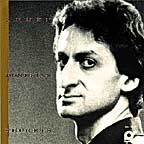
Buy
Andorinha (Jobim) / Seasons' Change (Donelian) / Resurrection (Donelian) / Broken Carousel (Donelian) / Dungeons and Dragons / Secrets (Donelian) / Astral Dancer (Donelian) / New Blues (Donelian) / Parting (Donelian) (CD only)
Armen Donelian | piano
Dick Oatts | tenor and soprano saxophone
Barry Danielian | trumpet and flugelhorn
Anthony Cox | bass
Bill Stewart | drums
Arto Tunçboyaciyan | percussion and voice(1988) Recorded February, 1988, New York, NY (CD/LP)
Quotes:
Beyond the talent for composition demonstrated by this pianist/leader, the spirit of adventure that breathes in this enterprise releases ephemeral currents and raises each theme to the level of epic musicality. Purity of execution, with unfailing inspiration, which seems to inhabit distant remembrances and revives with fervor some imaginary folklore. Raising in turn the most glistening or the most stirring colors that can be created, the jazz attained here hints at even more that it tells. Five stars for the album--and more--for the drummer. - Francois LaCharme, Jazz Hot Critics' Poll (France) ** #3 Jazz Album of 1988 **
Pianist/composer Donelian is now fulfilling the promise that critics have been attributing to him for the last several years. On his previous LP (4/87, p. 69), as well as on albums with Rory Stuart (12/83, p. 21) and Billy Harper (5/80, p. 26), Donelian established himself as an inventive pianist, schooled in the refined bop traditions of Bill Evans and Chick Corea. Now he has clearly come of age as a composer, player and leader. Donelian's compositions are characterized by elaborate but compelling lines. - Krin Gabbard, Cadence (1989)
After a premier Japanese recording (on Atlas) and a solo album on SunnySide ("A Reverie") in 1984, Donelian divulges here--in a quintet or sextet--his "Secrets." Superb sound from Dick Oatts on soprano, the discovery of Barry Danielian, rhythmic effectiveness: a true success. Eight selections and liner notes by Donelian on the LP, nine selections without the notes on CD: should we buy both? One sees a terrific future. - Eric Pingot, Jazz Magazine (France) (1989)
About seven years ago, Donelian released a trio album called "Stargazer" with Eddie Gomez and Billy Hart on the Atlas label, and also performed two concerts at Koseinenkin Hall as a member of the Billy Harper Quintet in 1979. His classically-trained, tasteful performance was full of jazz feeling. His sidemen for this album are skillful musicians, and except for Andorinha by Antonio Carlos Jobim all songs were written by Armen Donelian. Also, his ability as a leader, composer and arranger are well showcased. It is subtle and mature, and it is probably satisfying for him to make an album according to his own vision. - Shoichi Yui, Swing Journal (Japan) (1989)
Armen Donelian, Trio '87
(Odin NJ 4024) 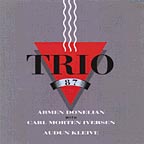
Buy
Song With No Name (Donelian/Iversen/Kleive) / Conception (Shearing) / Broken Carousel (Donelian) / Seasons' Change (Donelian) / In Your Own Sweet Way (Brubeck) / Secrets (Donelian) / Cockeyed Blues (Donelian) / Angel Eyes (Dennis/Brent) / Metropolitan Madness (Donelian)
Armen Donelian | piano
Carl Morten Iversen | bass
Audun Kleive | drums(1987) Recorded at Rainbow Studio, July, 1987, Oslo, Norway (CD) (Released only in Norway)
Quotes:
Three musicians meet and great music originates. That is the shortest thing you can say about this record. Trio '87 must be one of the greatest surprises in Norwegian jazz record production. Not that we don't know that these musicians, individually, are very good, but to witness such a successful musical meeting in a piano-trio format is something out of the ordinary in this country.
Let us therefore present: Armen Donelian, American pianist in his late thirties. The Norwegian audience first heard him when he played with Billy Harper's quintet in Molde almost ten years ago. His surname in particular bears witness to family roots in a Soviet republic with great unrest under its skies. About Armen the musician: He has issued three previous records under his own name, the first one with Eddie Gomez and Billy Hart, the second one alone and the third a sextet. After Molde, he has visited Norway on several occasions. Some of you will remember a memorable session when he sat in with Chet Baker at the Hot House playing "My Funny Valentine." A more beautiful rendition of this classic tune has hardly been heard.
He has toured with his Norwegian musicians and could be heard at the Cafe Nordraak in Oslo last year. Bass player Carl Morten Iversen is a veteran in Norwegian jazz, while the younger drummer Audun Kleive like Iversen has his background in bands like Extended Noise and Oslo 13, as well as with Terje Rypdal and The Chasers.
Trio '87 is--without disparagement on any part but rather its opposite--trio-playing in the Bill Evans tradition, a tradition later developed by the acoustic Chick Corea: this loose interplay where all three musicians are both more equal and freer than in traditional piano-trios. And this record is proof that great music originates. The first tune, "Song With No Name," is thus named because it came about while the engineer, Jan Erik Kongshaug, was setting the levels. It may be the finest track on the record and it sets the groove to a session worth listening to from the first note to the last. Carl Morten Iversen's fine bass work is excellent, in terms of both the sound and the music, and Audun Kleive is brilliant with his loose but at the same time distinct and extremely inventive playing. Donelian himself states in the liner notes that Norwegian musicians are very familiar with the American jazz tradition, but at the same time they are freer than him. They have a more relaxed, "loose" approach to playing, something that suits him just fine.
Anyway--here are nine compositions, the first by the trio, the second by George Shearing, most of the rest by Armen Donelian except for Dave Brubeck's "In Your Own Sweet Way"--everything delightfully performed. Don't let the oncoming dark season overwhelm you. Listen to Trio '87 instead. - Roald Helgheim, Klassekampen (Norway) (1988)Donelian teams up with a Norwegian rhythm section for his strongest release to date. Possibly the most impressive thing about Trio '87 is that it sounds as if this group has been playing together for years. The musical chemistry is such that the opener, a warm up improvisation for the trio with no theme, wound up being used as the lead off track. The piece has the accomplished looseness of the great Evans/Lafaro/Motian trio.
Donelian keeps growing as a player with each release. When one hears his tackle a piano favorite like "In Your Own Sweet Way" one hears original lines, an original rhythmic approach and an original arrangement. Strongly recommended, especially to those who favor piano trios. - Robert J. Iannopollo, Cadence (1989)This is one of the most pleasing trios I've heard in some time. Donelian, who studied piano with Richie Beirach, has a lilting, impressionistic touch to his playing, a keen ability to swing and some beautiful compositions. Donelian doesn't break any new ground or chart new musical directions on this disc, but he plays with such panache, who cares? Mood music in the best sense, this is the record you want after a long and arduous journey. - John Baxter, Option (1989)
Pianist Armen Donelian was responsible for one of the great unsung piano trio recordings of the '80's (Trio '87), a recording very much in the tradition of Bill Evans' trio music of the early 60's. - Robert J. Iannopollo, Cadence (1995)
Armen Donelian, A Reverie
Solo Piano
(Sunnyside SSC 1019)
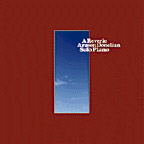
Buy
Metropolitan Madness (Donelian) / Nexus (Donelian) / Kjellaug (Donelian) / Harem Girl (Donelian) / Invocation (Donelian) / Contours Suite: Atoms in Motion, Prisms, Spirals, Mountains (Donelian) / A Reverie (Evans) / Stargazer (Donelian) / I Dream Too Much (Kern) / Morning Flower (Donelian) / Hymn (Donelian)
Armen Donelian | solo piano
(1986) Recorded 1984, New York, NY (LP) (Reissued on CD, 1995)
Quotes:
His Armenian origin, his perfect pianistic technique, his deep understanding of European harmony from Bach to the present, his association with some of the biggest names in Jazz during the first ten years of his professional career - all these factors combine to place Armen DONELIAN very firmly among those rare musicians of true "fusion," in the real sense of that term (not the con-fusion of that pitiful and impoverished music, bastardized jazz-rock and disco...God rest its soul). This album could appear to be an exercise in style, but it is certainly not that. On the contrary, it delivers an impression of formidable unity, due to the clarity of the language and to an irreproachable taste which creates a climate of both power and peace. It is therefore an important record, for two reasons. First, because it's a masterpiece (no one is forced to believe me, and it's this fact which authorizes me to be so peremptory). Second, this album is an open door to evolutionary jazz - there's a new road opened to creative musicians, which will perhaps permit them to leave the beaten path where so many of their elders have been trapped for too long. - Bernard Rabaud, Swing Jazz JournalFrance (1987)
Donelian is a pianist worth listening to. Donelian's music sparkles with buoyant energy. It's good to see him finally get a domestic release. - Robert J. Iannopollo, Cadence (1987)
Donelian has a fine technique, and his compositions have a lot of substance. - Amy Duncan, Christian Science Monitor (1987)
Donelian has a sure touch, good ideas, and a sense of humor. - Bob Doerschuck, Keyboard (1987)
Strong, but not overly virtuosic, technique, harmonic sensitivity and a pronounced melodic streak are the chief characteristics of his style. This recording also showcases a number of worthwhile compositions. "Metropolitan Madness" is a kind of '80's equivalent of Bud Powell's "Parisian Thoroughfare." "Stargazer" is an epic composition that deserves to become a standard. (Bill Evans would have liked this one.) "Contours Suite," in four movements, has a strong expressionist flavor. This CD is a straight reissue of the vinyl and is well worth checking out the second time around. - Robert J. Iannopollo, Cadence (1995)
Armen Donelian, Stargazer
(Atlas LA27-1011)
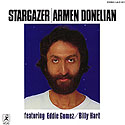
Stargazer / Free At Last / Southern Belle / Love's Endless Spin / Monday / Silent Afternoon
Armen Donelian | piano and composer (all tracks)
Eddie Gomez | bass
Billy Hart | drums(1981) Recorded April 15, 1980, New York, NY (LP) (Released only in Japan)
Quotes:
The pianist with a slightly unusual name of Armen Donelian is a 30 year old New Yorker. Although he came to Japan in 1979 as a member of the Billy Harper Quintet, most people in Japan probably have not heard of him yet. However, his first LP has caught the attention of the Japanese before the rest of the world.
Donelian's lyrical touch with an emphasis on the right hand and beautiful tone can be identified with the music of Richie Beirach. His sharp sensitivity can be felt by the way in which he draws from the music of Bill Evans and Chick Corea. In his new album, Donelian displays his intellectual yet attractive play with the support from veterans Eddie Gomez (b) and Billy Hart (d). But, Gomez does not simply stay in a rhythm support role. Instead, he encourages Donelian, and through interplay, he succeeds in heightening the wonderful tension throughout this album.
Including one jointly composed song, all 6 songs are Donelian's originals. Donelian possesses an uncommon talent as a composer, as well. If the expanse of the music could be maintained throughout the "play," this album would be perfect. However, it is evident that Armen Donelian is a rising star pianist. - Swing Journal/Japan (1981)
Roy Ayers, Step Into Our Life
(Polydor)
Roy Ayers | vibraphone
Wayne Henderson
Armen Donelian |piano
Willi Allen | bass
Bernard Purdie | drums(1977) New York, NY (LP)
Cosmology, Cosmology
(Vanguard VSD 79394)
Phases of the Moon / In the Limbo / Roadsigns / Sky / Willow Land / Out From the Kiva / Superman / City Fever / Into The Forest
Dawn Thompson | voice and percussion
Bob Jospé | drums and percussion
John D'earth | trumpet and flugelhorn
Dave Glenn | trombone
Armen Donelian | piano and synthesizer
Rick Kilburn | bass and electric bass
Colin Walcott | sitar and percussion
Reed Wasson | tamboura(1977) New York, NY (LP)
Billy Harper, The Believer
(Baystate RVJ 6083)
Is It Not True, Simply Because You Cannot Believe It? / I Do Believe / Believe, For It Is True!
Billy Harper | tenor saxophone
Chris Albert | trumpet
Armen Donelian | piano
Gregg Maker | bass
Newman Baker | drums(1980) New York, NY (LP) (Released only in Japan)
Billy Harper, The Billy Harper Quintet
(Poljazz PSJ 99)
Soran Bushi B.H. / Call Of The Wild and Peaceful Heart
Billy Harper | tenor saxophone
Chris Albert | trumpet
Armen Donelian | piano
Wayne Dockery | bass
Newman Baker | drums(1980) Recorded live at Jazz Jamboree Festival, Warsaw, Poland (LP) (Released only in Poland)
Billy Harper, Trying To Make Heaven My Home
(MPS 0068.234)
Trying to Make Heaven My Home / Insight / Love On The Sudan
Billy Harper | tenor saxophone
Everett Hollins | trumpet
Armen Donelian | piano
Wayne Dockery | bass
Malcom Pinson | drums(1979) Stuttgart, Germany (LP) (Released only in Germany)
Datevik Hovanesian, Listen To My Heart
(Sony SA 02)
Yerginkn Ambele / Chem Grna Khagha / Andzrevn Yekav / Yarimo / Shalakho / Ari Indz Angach Gal / Hov Arek / Gakavik / Mokats Harsner / Ervoom Em / Es Gisher Loosniak Gisher
Datevik Hovanesian | voice
Armen Donelian | piano/arranger
David Finck | bass
Portinho | drums
Ben Riley | drums
Paquito D'Rivera | alto saxophone
Alex Foster | alto saxophone
Arto Tunçboyaciyan | percussion
Steve Berrios | percussion
George Avakian | producer(1998) Recorded 1996, New York, NY (CD) (Released only in France)
Julie Lyonn Lieberman, Mixing America
(Huiksi Music JLL0003)
The Tree of Thorns / Eagle Bones / Mixing America / Mixing America Epilogue / Orphan Boy / Violinova / The Sandman / Fiddle, Sing For Me / Lady Bop
Julie Lyonn Lieberman | violin, voice
Armen Donelian | piano
Dan Kleinman | synthesizer
Jeff Eckels | bass
Steve Johns | drums
Tigger Benford | percussion
Toby, Twining | voice
Joan Henry | voice
Shi Zheng Chen | voice
Tiye Giraud | voice
Mark Johnson | voice
Gregory Purnhagen | voice
Rebecca Weintraub | voice(1996) New York, NY (CD)
Night Ark, Petals on Your Path
(Universal/EmArcy 546616)
Petals On Your Path / The Invisible Lover / Melon / The Long Goodbye / Love Is Not In Your Mind / Anna Tol' Ya / Skating Is Art / I Am Dancing With The Devil / Intz Mi Khntir (Don't Ask Of Me) / Fly Away / Marsala Dreams
Ara Dinkjian | oud
Armen Donelian | piano
Marc Johnson | bass
Arto Tunçboyaciyan | percussion(1999) New York, NY (CD/LP/Cassette)
Quotes:
The three Armenian musicians - Ara Dinkjian (oud), Armen Donelian (piano) and Arto Tunçboyaciyan (voice, percussion) - and bassist Marc Johnson have together created a music all their own. A rich palette of the most diverse pieces coexists in Night Ark's repertoire. From the primeval songs of the steppe to the most complex Jazz chords. - Jurg Sommer, Aarganer Zeitung/Switzerland (2000)
Night Ark, In Wonderland
(PolyGram/EmArcy 534471)
Very Nice / They Love Me 15 Feet Away / Is That How Loving You Goes / Lisa / Going With Abandon / Lullaby For The Sun / In Wonderland / Keesher Bar /Heru Mertar / Going With Abandon (Reprise)
Ara Dinkjian | oud
Armen Donelian | piano
Marc Johnson | bass
Arto Tunçboyaciyan | percussion(1996) New York, NY (CD/LP/Cassette)
Night Ark, Moments
(RCA/Novus 3028)
Wind (Tuncboyaciyan) / You've Got A Friend (King) / Offering (Dinkjian) / Nocturne: Dusk, Frenzy, After Hours (Donelian) / Baby Elephant (Tuncboyaciyan) / Over The Rainbow (Arlen) / Yazoo-Firat (Dinkjian) / Adolescence (Dinkjian) / Moments (Dinkjian) / Danny Boy (Traditional)
Ara Dinkjian | oud
Armen Donelian | piano
Ed Schuller | bass
Arto Tunçboyaciyan | percussion(1987) New York, NY (CD/LP/Cassette)
Quotes:
The most ambitious tune on "Moments" is a three-part suite composed by keyboardist Armen Donelian, titled "Nocturne." Here, the possibilities inherent in a fusion of Middle Eastern traditional music and American Jazz are extensively explored. - St. Louis Press-Journal (1988)
Donelian's own "Nocturne," a three-part, nine-minute suite, is a masterful evocation of Armenian culture, and his accents on the beautiful "Wind" and "Adolescence" are just right. - Sweet Potato/Maine (1988)
Bobby Vince Paunetto, Reconstituted
(RSVP Jazz Records, CD1778)
Silva! Horn! & Down Pat! /Reconstituted /Foreign Glasses /Slovenly Hilled Curves /Dirt Cheap Meets Dirt /In the Harbor of Cadiz /Jazz for the Silent Majority /Turning on the Memories /Emotional Currency /The Contra Bean /Co-Hearsed /My Brother The Great!
Bobby Vince Pauntetto, composer, arranger, conductor, producer
Todd Anderson, saxophone and flute
Tom Harrell, trumpet
Larry Farrell, trombone
Glenn Drewes, trumpet
Gary Smulyan, baritone saxophone, bass clarinet
Billy Drewes, soprano and alto saxophone, flute, drums
Bill O'Connell, piano, electric piano
Armen Donelian, piano
Mike Richmond, bass
John Riley, drums(1999) Paramus, NJ (CD)
Bobby Vince Paunetto, Commit to Memory
(Pathfinder 1776)
Spanish Maiden /Taz /Catalano /Dragon Breath /Mediterrano / Little Rico's Theme /Delta /Coral /Good Bucks
Bobby Vince Pauntetto, vibraphone, piano, percussion
Tom Harrell, trumpet
Mike Richmond, bass
Abraham Laboriel, bass
Billy Drewes, saxophone
Glenn Drewes, trumpet
Armen Donelian, piano
Eddy Martinez, piano
Todd Anderson, saxophone and flute
Ronnie Cuber, baritone saxophone and bass clarinet
Ed Byrne, trombone
Tom Sala, drums
Fred Munar, percussion
John Scofield, guitar
Frank Malabe, percussion
Jon Kass, violin and viola
David Eyges, cello
Justo Almario, saxophone
Andy Gonzalez, bass
Jerry Gonzaloez, percussion
Steve Thornton, percussion
Eddie Rivera, bass
Gary Anderson, saxophone
Steve Slagle, flute
Milton Cardona, percussion
Paul Moen, saxophone
Orpheus Gaitanopoulos, voice
Gene Golden, percussion
Bretton Scott, voice
Manny Oquendo, percussion
John Rogriguez, percussion
Charlie Burnham, violin
Alfredo De La Fe, violin
Ashley Richardson, viola
Ron Lipscomb, cello(1976/LP) New York, NY (Reissued on CD in 1998 on Bomba Records BOM 22085 in Japan only)
Bobby Vince Paunetto, Composer in Public
(RSVP Jazz Records CD1777)
You're Jiving Me Crazy /Movies /Bottle The Edge /Romancing a Whisper /When I Got Disconnected /Composer In Public /The Beautifull Flawed Game /You're a Wonderment /Say It Now /The Foundlings /Jacket Listeners /If You...
Bobby Vince Pauntetto, vibraphone, piano, percussion
Bill O'Connell, piano
Armen Donelian, piano
Mike Richmond, bass
Chip Jackson, bass
John Riley, drums
Bill Bickford, guitar and voice
Glenn Drewes, trumpet
Billy Drewes, saxophone
Todd Anderson, saxophone and flute
Gary Smulyan, baritone saxophone
Jon Kass, violin and viola
Christine Gummere, cello
Madeline Kole, voice
Devorah Segall, voice
Ann Belmont, voice and guitar(1996) New York, NY
Mongo Santamaria, Sofrito
(Vaya/Fania JMVS 53)
*Iberia (A. Donelian)/ *Cruzán (A. Donelian)/ *Spring Song (A. Donelian)/ Sofrito / O Mi Shango / Five On The Color Side (W. Allen)/ Secret Admirer (W. Allen)/ Olive Eye (M. Sheller)/ Princess (M. Sheller)
Mongo Santamaria, percussion
Roger Rosenberg, saxophone and flute
Mike DiMartino, trumpet
Al Williams, saxophone and flute
Armen Donelian, piano
Eddie Rivera, bass
Steve Berrios, drums
Greg Jarmon, percussion(1976/LP) New York, NY (Reissued on CD)
Grammy Award Nominee. Contains 3 Donelian (*) compositions.
Mongo Santamaria, Mongo and Justo
(Vaya/Fania JMVS 44)
Cantandole al Amor /Kindimbia /Miedo /Serpentina /Ubane (Canto Abacua) /Manana /Come Candela /No Me Importa /Vengan Pollos /Cumbia Tipica
Mongo Santamaria, percussion
Justo Batencourt, voice
Roger Rosenberg, saxophone and flute
Mike DiMartino, trumpet
Al Williams, saxophone and flute
Armen Donelian, piano
Eddie Rivera, bass
Steve Berrios, drums
Greg Jarmon, percussion(1976) New York, NY (LP)
Mongo Santamaria, A La Carte
(Vaya/Fania)
Mongo Santamaria, percussion
Roger Rosenberg, saxohpone and flute
Mike DiMartino, trumpet
Al Williams, saxophone and flute
Bill O'Connell, piano
Armen Donelian, piano
Eddie Rivera, bass
Steve Berrios, drums
Greg Jarmon, percussion(1976) New York, NY (LP)
Mongo Santamaria, Afro Indio
(Vaya/Fania XVS 38)
Creepin' /Funk Up /Mambomongo /Funk Down /Los Indios /Lady Marmalade /The Promised Land /What You Don't Know /Song For You /Midnight and You
Mongo Santamaria, percussion
Justo Almario, saxophone and flute
Ray Maldanado, trumpet
Al Williams, saxohpone and flute
Armen Donelian, piano
Willi Allen, bass
Steve Berrios, drums
Greg Jarmon, percussion(1975) New York, NY (LP)
Quotes:
Pianist Donelian seems to have learned the arts of negotiating Latin progression and rhythms; his flexibility should extend in several directions. - Howard Mandel, Downbeat - ** 4 Stars ** (1975)
Rory Stuart, Hurricane
(SunnySide 1021)
Rhythm-a-Ning (T. Monk) /Hurricane (R. Stuart) /Sweet Thing (R. Stuart) /Lembranças (R. Stuart) /Reoccuring Dreams (R. Stuart) /The Scattered Brotherhood (A. Donelian) /The Ancient Ones (R. Stuart) /Push-Pull (R. Stuart
Rory Stuart, guitar
Armen Donelian, piano
Anthony Cox, bass
Keith Copeland, drums(1987) New York, NY (CD/LP)
Rory Stuart, Nightwork
(Cadence 1016)
Rory Stuart, guitar
Armen Donelian, piano
Calvin Hill, bass
Keith Copeland, drums
(1984) Recorded live at Seventh Avenue South, New York, NY (LP)
Quotes:
Brilliant pianist Armen Donelian... cascading solos and muscular block chording. - Bill Milkowski, Downbeat - 4 Stars (1985)
Armen Donelian acquits himself best...as valuable an exposition of his talents as it is of Stuart's. Donelian is a crisp, harmonically oriented pianist whose fleet attack sets the standard for the rest of the quartet. He's a distinctive stylist. - Kevin Whitehead, Jazz Times (1984)
Various Artists incl. Armen Donelian Quintet, Positively Armenian
2
(Positively Armenian PA 102)
Nohr Ike (A. Donelian/S. Baronian)
Sudan Baronian, saxophone
Barry Danielian, trumpet
Armen Donelian, piano
Ralph Hamperian, bass
Paul Motian, drums(1986) New York, NY (CD/LP/Cassette)
Various Artists incl. Billy Harper Quintet, Jazz Jamboree 1980
(Muza SX 1983)
Insight (B. Harper)
Billy Harper, saxophone
Chris Albert, trumpet
Armen Donelian, piano
Wayne Dockery, bass
Newman Baker, drums(1980) Live performance at Jazz Jamboree Festival, Warsaw, POLAND (LP, Released only in Poland)